
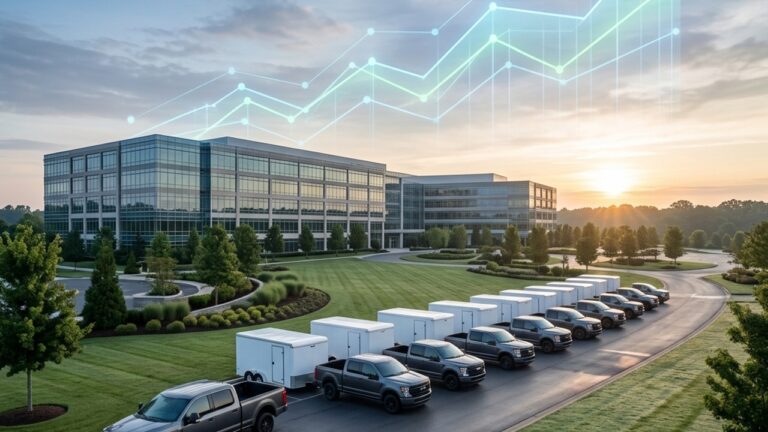
Many landscaping business owners easily clear their first million in revenue through sheer force of will, long hours, and word of mouth. But moving from $1 million to $5 million requires an entirely different business growth strategy. At this stage, raw hustle no longer scales; the bottleneck is no longer a lack of leads, but a lack of operational infrastructure and systemized digital acquisition.
Most digital agencies will simply advise you to increase your Facebook Ads budget or buy more shared leads... This is a critical error. ALWAYS. Pumping unqualified volume into an unsystematized business results in operational chaos, burned out crews, and plummeting profit margins. Stop buying bad leads. Breaking the revenue ceiling requires an elite transition from "time for money" to an automated growth machine.
Let us introduce you to the structural blueprint required to scale your landscaping marketing without destroying your operations in the process.
Introducing the Landscaping Scale Framework
The standard landscaping company operates on a reaction-based model: the phone rings, an estimator drives 45 minutes to quote a job, the client hesitates, and the follow-up falls through the cracks. As you attempt to scale this model, the cracks become fatal.
To successfully navigate scaling a service business, you must transition to a proactive, filtering-first strategy. The Landscaping Scale Framework revolves around three non-negotiable pillars: maximizing route density through hyper-local visibility, automating lead qualification so your sales team only speaks to high-ticket prospects, and leveraging digital systems for client retention. As noted by business scaling experts, removing the owner from the day-to-day lead chase is the ONLY way to build a company that runs, and grows, independently.
This is not just about getting more clicks. It is about acquiring the right clicks in the exact neighborhoods where you already have trucks deployed.
Pillar 1: Transitioning from Hustle to Systematized Route Density
The fastest way to burn profit in the landscaping industry is windshield time. Sending crews across three different counties limits the number of jobs they can complete and skyrockets fuel and maintenance costs.
As you scale past the $1M mark, your digital marketing must shift focus toward Route Density. You achieve this by deploying hyper-targeted Local SEO and precision-geo-fenced advertising campaigns.
Owning Your Primary Zip Codes
You must establish absolute dominance in your primary service areas before expanding. This means your Google Business Profile must rank in the top three for high-intent searches like "commercial landscapers near me" or "high-end hardscaping." A robust organic presence ensures that when neighbors see your trucks, a quick Google search immediately validates your authority.
- Service Area Pages: Build dedicated, highly-optimized pages on your website for every specific city or high-net-worth neighborhood you target.
- Geo-Fenced Social Ads: Run Meta (Facebook/Instagram) ad campaigns restricted exclusively to the zip codes where you are actively working, showcasing before-and-after photos of properties in those exact areas.
- Review Velocity: Implement an automated SMS system to request reviews from satisfied clients immediately after job completion, heavily weighting your profile in your core operating radius.

Pillar 2: Automating the Lead Qualification Funnel
When you are trying to reach $5M, answering every phone call to explain your minimum project size is a catastrophic waste of resources. Your digital presence must act as a ruthless filter, qualifying prospects before they ever reach your estimators.
A digital transformation involves upgrading your website from a digital brochure into a strategic lead generation funnel. This is where partnering with a specialized web design agency becomes critical. You need a platform integrated directly with your CRM.
The Self-Qualifying Website
Instead of a generic "Contact Us" form, implement a multi-step conditional logic form. Ask prospects for their property type, the scope of work, and their budget range. If a prospect selects a budget below your minimum threshold, the system automatically redirects them to a polite "We are not a fit" page or offers a DIY resource guide.
If the prospect meets your criteria, the system automatically books them into your estimator's calendar and triggers an automated email sequence featuring your portfolio, insurance documentation, and video testimonials. By the time your team arrives at the property, the prospect is already pre-sold on your premium value.
Run a Scalable Service Business
- Manage your operations and fleet from one powerful platform
- Keep your work, team, and revenue moving forward
- Get paid faster from first quote to final payment

Pillar 3: High-Ticket Client Retention and Upselling
Acquiring a new landscaping client costs five to ten times more than retaining an existing one. Reaching the $5M tier requires maximizing the lifetime value of every commercial contract and high-end residential account you secure.
Your digital marketing strategy must include automated retention protocols. If you install a $50,000 hardscape, your CRM should automatically email that client six months later offering a specialized maintenance package or seasonal sealing services. If you manage commercial properties, your systems should trigger contract renewal sequences 60 days before expiration, highlighting the reliability and ROI you have delivered over the past year.
If you want to know how to market your online business right, you must understand that backend automation is just as critical as frontend lead generation. You are no longer just selling mulch and mowing; you are selling peace of mind, delivered systematically.
Putting the Framework into Motion (Why You Need a Partner)
Implementing targeted local SEO, CRM integrations, conditional logic funnels, and automated retention sequences requires deep technical expertise. The debate of hiring an agency vs in-house becomes irrelevant when you realize that building this infrastructure internally would require hiring a web developer, an SEO specialist, an ad buyer, and a copywriter.
To scale rapidly without operational bloat, you need a strategic growth partner capable of architecting the entire digital ecosystem. This allows you, the CEO, to focus on hiring elite crews, managing fleet logistics, and closing high-ticket commercial accounts while the digital machine hums in the background.
Ready to Break the $1M Revenue Ceiling?
Stop wasting money on unqualified leads and start building a predictable, scalable growth machine. Request our Free Competitor Analysis ($834 Value) to see exactly how the top landscaping companies in your market are dominating search and securing high-ticket contracts. Limited Spots available this month.
Get Your Free Competitor AnalysisFrequently Asked Questions About Scaling Landscaping Businesses
What is the best marketing strategy for scaling a landscaping business?
The best strategy moves away from buying shared leads and focuses on building Route Density through highly targeted Local SEO, Google Local Services Ads, and automated CRM funnels that qualify prospects before you speak to them.
How much should a $1M landscaping business spend on marketing?
Growth-focused landscaping companies typically allocate 5% to 8% of their gross revenue toward marketing, provided the spend is directed into measurable, high-ROI channels rather than blanket brand awareness.
Should I hire an in-house marketer or a digital agency to scale?
Partnering with a specialized digital agency is generally more cost-effective for scaling home service businesses, as it grants you access to an entire team of experts (SEO, paid search, web development) for a fraction of the cost of one in-house salary.
How does route density impact landscaping profitability?
Route density is designed to maximize ROI by reducing fuel costs, limiting non-billable driving time, and allowing crews to complete more jobs per day. Digital marketing should be geo-fenced to build density in specific, high-value zip codes.
Why do I need a CRM for my landscaping company?
A CRM (Customer Relationship Management) system automates lead follow-ups, filters out unqualified prospects, and triggers seasonal up-sell campaigns, ensuring that no revenue falls through the cracks as your job volume increases.